Back
Back
The Real Cost of Reactive Maintenance
The value of a CMMS and how it can help your organization reduce maintenance cost
Feb 24, 2026


A machine stops. A team scrambles. A repair happens, eventually. And everyone moves on.
This is the daily reality for thousands of maintenance teams around the world. And as long as the machine starts again, it feels fine. The real cost never shows up on a single invoice. It accumulates quietly, invisibly, across hundreds of incidents that were never tracked, never analyzed, and never prevented.
Here is what that actually looks like in numbers.
Why reactive maintenance feels cheaper than it is
The logic is seductive. You only pay when something breaks. No spending on inspections that "find nothing." No hours logged against equipment that's running fine. On paper, the reactive approach looks lean.
In practice, it front-loads hidden costs onto every emergency: expedited parts at two or three times normal price, overtime labour, production halts, customer penalties, and — in healthcare — the worst case scenario of equipment failure during patient care.
The teams we speak with rarely track these costs in aggregate. They absorb them piecemeal across departments -parts on one budget, labour on another, lost output not counted at all. When you add them up, the picture changes completely.
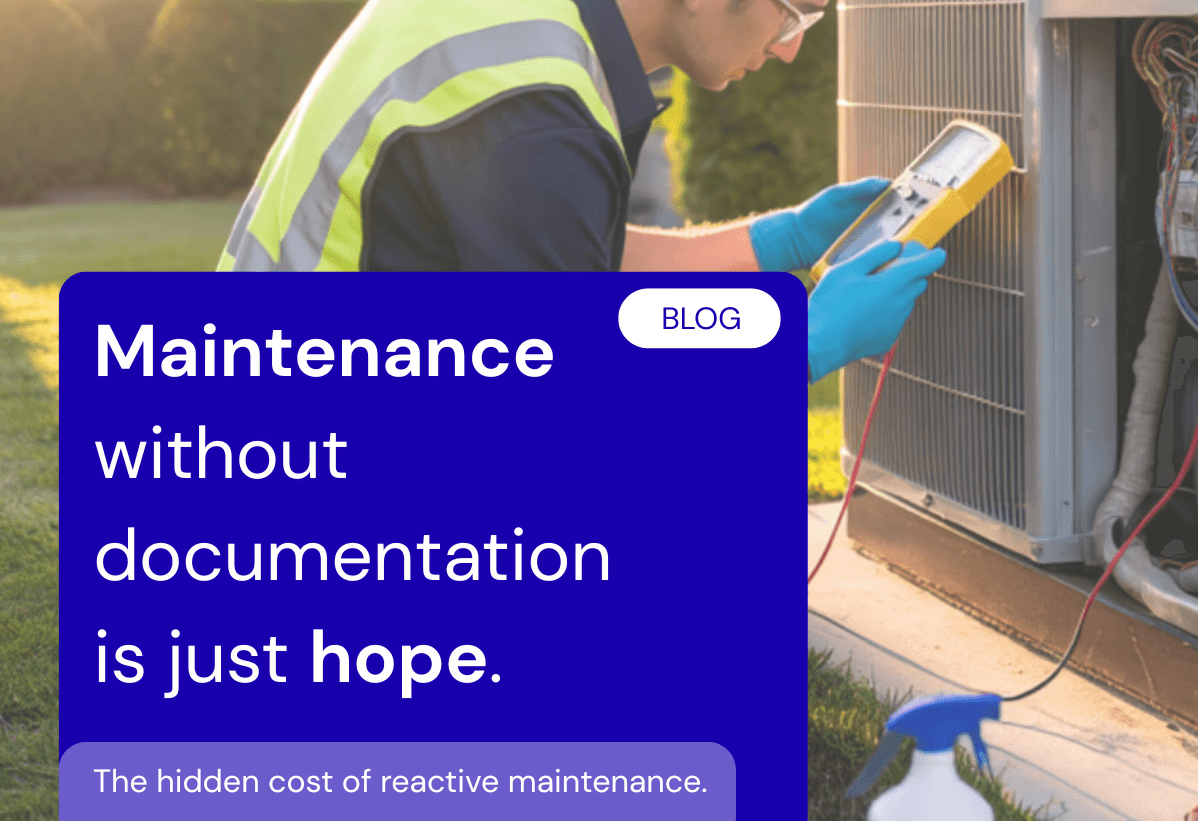
"Maintenance without documentation is just hope. And hope is not a maintenance strategy."
The industries where this hits hardest
Not all downtime is equal. A hotel laundry machine failing at 6am on a Monday is an inconvenience. A ventilator failing in an ICU is catastrophic. A production line stopping at a manufacturing plant during a customer delivery window has a contractual cost.
The industries where reactive maintenance does the most damage are also the ones where maintenance budgets are tightest and teams are most stretched: healthcare, manufacturing, hospitality, and education.
We have spoken with hospitals managing over 1,000 medical devices with a team of two engineers. Factories with no centralized record of when critical equipment was last serviced. Hotels where the maintenance log is a WhatsApp group.
These are not outliers. This is the norm.
5 signs your team is stuck in reactive mode
Your team only knows an asset is broken when someone reports it, not before.
You have no documented maintenance history for your critical assets.
Spare parts are ordered after a breakdown, not in anticipation of one.
Your most experienced technician carries critical information in their head, not in a system.
A compliance audit would require days of manual document gathering to pass.
Making the shift: where to start
Moving from reactive to preventive maintenance does not require a six-month transformation project. The first step is simple: know what you own.
A complete, accurate asset register -listing every piece of equipment, its location, age, warranty status, and service history, is the foundation everything else is built on. Most teams do not have one. Not because they do not want one, but because building it has always seemed like too much work.
It does not have to be. A good CMMS turns that asset register into a living record that updates every time a technician completes a work order, performs an inspection, or logs a repair.
Over time, that data becomes your most valuable maintenance tool. It tells you which assets break most often, which ones cost the most to maintain, and — critically — which ones are due for service before they fail.
The bottom line
Reactive maintenance is not a cost-saving strategy. It is a cost-deferral strategy. You pay less today and more, much more, when something fails at the worst possible time.
The teams that make the shift to preventive maintenance do not do it because they have more budget. They do it because they finally have visibility. Once you can see what your assets are doing, the case for acting on that information makes itself.
That visibility is exactly what Arcmedix is built to give you.

A machine stops. A team scrambles. A repair happens, eventually. And everyone moves on.
This is the daily reality for thousands of maintenance teams around the world. And as long as the machine starts again, it feels fine. The real cost never shows up on a single invoice. It accumulates quietly, invisibly, across hundreds of incidents that were never tracked, never analyzed, and never prevented.
Here is what that actually looks like in numbers.
Why reactive maintenance feels cheaper than it is
The logic is seductive. You only pay when something breaks. No spending on inspections that "find nothing." No hours logged against equipment that's running fine. On paper, the reactive approach looks lean.
In practice, it front-loads hidden costs onto every emergency: expedited parts at two or three times normal price, overtime labour, production halts, customer penalties, and — in healthcare — the worst case scenario of equipment failure during patient care.
The teams we speak with rarely track these costs in aggregate. They absorb them piecemeal across departments -parts on one budget, labour on another, lost output not counted at all. When you add them up, the picture changes completely.
"Maintenance without documentation is just hope. And hope is not a maintenance strategy."
The industries where this hits hardest
Not all downtime is equal. A hotel laundry machine failing at 6am on a Monday is an inconvenience. A ventilator failing in an ICU is catastrophic. A production line stopping at a manufacturing plant during a customer delivery window has a contractual cost.
The industries where reactive maintenance does the most damage are also the ones where maintenance budgets are tightest and teams are most stretched: healthcare, manufacturing, hospitality, and education.
We have spoken with hospitals managing over 1,000 medical devices with a team of two engineers. Factories with no centralized record of when critical equipment was last serviced. Hotels where the maintenance log is a WhatsApp group.
These are not outliers. This is the norm.
5 signs your team is stuck in reactive mode
Your team only knows an asset is broken when someone reports it, not before.
You have no documented maintenance history for your critical assets.
Spare parts are ordered after a breakdown, not in anticipation of one.
Your most experienced technician carries critical information in their head, not in a system.
A compliance audit would require days of manual document gathering to pass.
Making the shift: where to start
Moving from reactive to preventive maintenance does not require a six-month transformation project. The first step is simple: know what you own.
A complete, accurate asset register -listing every piece of equipment, its location, age, warranty status, and service history, is the foundation everything else is built on. Most teams do not have one. Not because they do not want one, but because building it has always seemed like too much work.
It does not have to be. A good CMMS turns that asset register into a living record that updates every time a technician completes a work order, performs an inspection, or logs a repair.
Over time, that data becomes your most valuable maintenance tool. It tells you which assets break most often, which ones cost the most to maintain, and — critically — which ones are due for service before they fail.
The bottom line
Reactive maintenance is not a cost-saving strategy. It is a cost-deferral strategy. You pay less today and more, much more, when something fails at the worst possible time.
The teams that make the shift to preventive maintenance do not do it because they have more budget. They do it because they finally have visibility. Once you can see what your assets are doing, the case for acting on that information makes itself.
That visibility is exactly what Arcmedix is built to give you.
A machine stops. A team scrambles. A repair happens, eventually. And everyone moves on.
This is the daily reality for thousands of maintenance teams around the world. And as long as the machine starts again, it feels fine. The real cost never shows up on a single invoice. It accumulates quietly, invisibly, across hundreds of incidents that were never tracked, never analyzed, and never prevented.
Here is what that actually looks like in numbers.
Why reactive maintenance feels cheaper than it is
The logic is seductive. You only pay when something breaks. No spending on inspections that "find nothing." No hours logged against equipment that's running fine. On paper, the reactive approach looks lean.
In practice, it front-loads hidden costs onto every emergency: expedited parts at two or three times normal price, overtime labour, production halts, customer penalties, and — in healthcare — the worst case scenario of equipment failure during patient care.
The teams we speak with rarely track these costs in aggregate. They absorb them piecemeal across departments -parts on one budget, labour on another, lost output not counted at all. When you add them up, the picture changes completely.
"Maintenance without documentation is just hope. And hope is not a maintenance strategy."
The industries where this hits hardest
Not all downtime is equal. A hotel laundry machine failing at 6am on a Monday is an inconvenience. A ventilator failing in an ICU is catastrophic. A production line stopping at a manufacturing plant during a customer delivery window has a contractual cost.
The industries where reactive maintenance does the most damage are also the ones where maintenance budgets are tightest and teams are most stretched: healthcare, manufacturing, hospitality, and education.
We have spoken with hospitals managing over 1,000 medical devices with a team of two engineers. Factories with no centralized record of when critical equipment was last serviced. Hotels where the maintenance log is a WhatsApp group.
These are not outliers. This is the norm.
5 signs your team is stuck in reactive mode
Your team only knows an asset is broken when someone reports it, not before.
You have no documented maintenance history for your critical assets.
Spare parts are ordered after a breakdown, not in anticipation of one.
Your most experienced technician carries critical information in their head, not in a system.
A compliance audit would require days of manual document gathering to pass.
Making the shift: where to start
Moving from reactive to preventive maintenance does not require a six-month transformation project. The first step is simple: know what you own.
A complete, accurate asset register -listing every piece of equipment, its location, age, warranty status, and service history, is the foundation everything else is built on. Most teams do not have one. Not because they do not want one, but because building it has always seemed like too much work.
It does not have to be. A good CMMS turns that asset register into a living record that updates every time a technician completes a work order, performs an inspection, or logs a repair.
Over time, that data becomes your most valuable maintenance tool. It tells you which assets break most often, which ones cost the most to maintain, and — critically — which ones are due for service before they fail.
The bottom line
Reactive maintenance is not a cost-saving strategy. It is a cost-deferral strategy. You pay less today and more, much more, when something fails at the worst possible time.
The teams that make the shift to preventive maintenance do not do it because they have more budget. They do it because they finally have visibility. Once you can see what your assets are doing, the case for acting on that information makes itself.
That visibility is exactly what Arcmedix is built to give you.
Are you ready to convert more leads into customers?
Join 1000+ agencies, startups & consultants closing deals with Convert CRM
Are you ready to convert more leads into customers?
Join 1000+ agencies, startups & consultants closing deals with Convert CRM
Are you ready to convert more leads into customers?
Join 1000+ agencies, startups & consultants closing deals with Convert CRM
Latest posts
Discover other pieces of writing in our blog